
How PTE Academic Is Scored: The 10-90 Scale, AI Scoring, and the 2025 Updates
PTE Academic is scored on a 10 to 90 scale. You get one overall score, four communicative skill scores (Listening, Reading, Speaking, and Writing), and a private enabling-skills breakdown that only you can see. Pearson made two scoring changes in 2025 that are worth knowing about before you book your test.
This guide explains what each part of your PTE score report means, how Pearson grades your answers, and how your PTE score lines up with CEFR levels and IELTS bands.
Table of Contents
- What's New in PTE Scoring in 2025
- What's on Your PTE Score Report
- The 10-90 Scale and CEFR Alignment
- The Four Communicative Skills
- How PTE Is Scored: AI Plus Human Marking
- Enabling Skills: Your Private Score Breakdown
- What's a Good PTE Score?
- Score Reporting and Validity
- Frequently Asked Questions
What's New in PTE Scoring in 2025
Pearson updated PTE Academic in 2025 with two changes that affect scoring:
- Human marking added to seven question types. Since the update, a human expert also reviews the Content score on seven question types: Describe Image, Retell Lecture, Summarize Written Text, Write Essay, Summarize Spoken Text, Summarize Group Discussion, and Respond to a Situation. The AI still scores Pronunciation, Oral Fluency, and most other traits on its own. If the AI and the human disagree on Content, a second human makes the final call.
- Two new question types. Pearson added Summarize Group Discussion and Respond to a Situation in 2025. These are both speaking tasks, and they are part of the seven question types that use double marking.
The 10 to 90 scale, the four communicative skills, score validity, and the score report itself did not change. Everything else in this guide applies the same way as before the update. For Pearson's own write-up of the changes, see their PTE Academic updates 2025 page.
What's on Your PTE Score Report
After your test, you receive a score report through Pearson's myPTE portal. The report shows five visible numbers:
- One Overall score, from 10 to 90.
- Four communicative skill scores, also each from 10 to 90: Listening, Reading, Speaking, and Writing.
Below the visible scores, your enabling skills profile shows six diagnostic sub-scores (Grammar, Oral Fluency, Pronunciation, Spelling, Vocabulary, and Written Discourse). These are only for you. They are not shared with universities or governments.
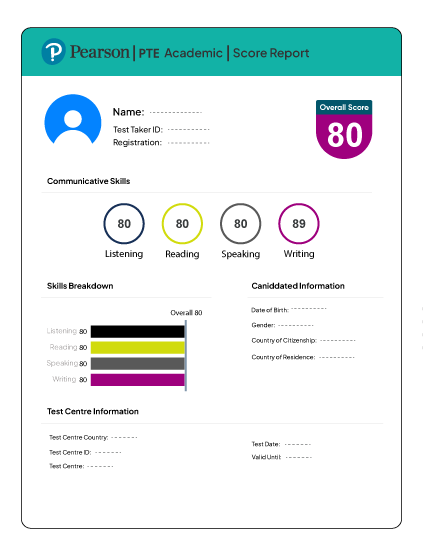
One important point from Pearson's Score Guide: your overall score is not the average of your four communicative skill scores. Pearson calculates the overall from your performance across the whole test, including integrated-skills questions (more on those below). So the overall score can be higher or lower than the simple average of the four skills.
The 10-90 Scale and CEFR Alignment
The PTE Academic scale runs from 10 to 90 in 1-point steps. Pearson aligns each PTE score range to a CEFR level (A1 through C2). The official chart also shows the IELTS band each PTE range matches.
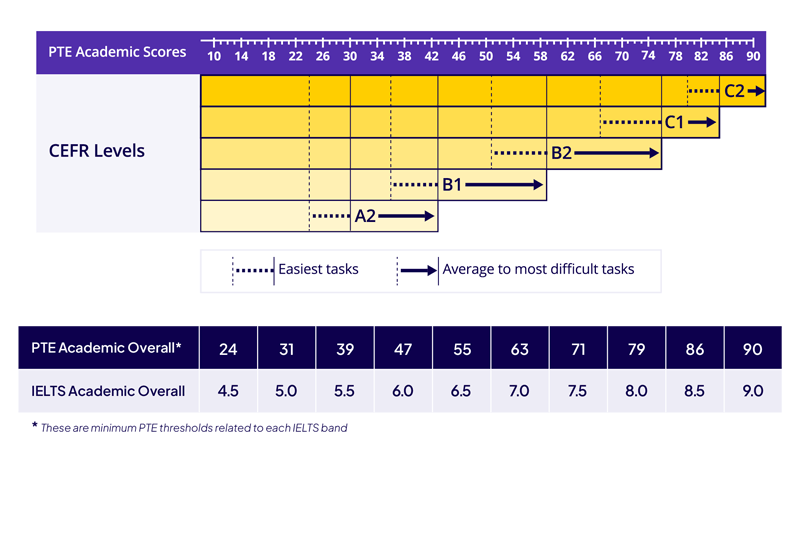
Pearson's official PTE to IELTS minimum thresholds (per the Score Guide):
- PTE 24 = IELTS 4.5
- PTE 31 = IELTS 5.0
- PTE 39 = IELTS 5.5
- PTE 47 = IELTS 6.0
- PTE 55 = IELTS 6.5
- PTE 63 = IELTS 7.0
- PTE 71 = IELTS 7.5
- PTE 79 = IELTS 8.0
- PTE 86 = IELTS 8.5
- PTE 90 = IELTS 9.0
To convert your exact PTE score to an IELTS band, TOEFL score, or Duolingo English Test score, use our score converter pages:
- PTE to IELTS score converter
- PTE to TOEFL score converter
- PTE to Duolingo English Test score converter
The Four Communicative Skills
Each of Listening, Reading, Speaking, and Writing is scored from 10 to 90 separately. But because some PTE question types test more than one skill at the same time, your work on a single question can count toward more than one skill score.
Pearson calls these integrated-skills questions. A few examples:
- Repeat Sentence (you hear a sentence and say it back) counts toward both your Listening score and your Speaking score.
- Summarize Written Text (you read a passage and write one sentence summarizing it) counts toward both your Reading score and your Writing score.
- Write from Dictation (you hear a sentence and type it) counts toward both your Listening score and your Writing score.
That is why your overall score is not just the average of the four communicative skills. The overall reflects your work across the whole test, including how you scored on integrated questions that feed two skills at once.
How PTE Is Scored: AI Plus Human Marking
PTE Academic uses Pearson's AI scoring engine to grade most answers automatically. The same engine has been used for years to score Pronunciation, Oral Fluency, Grammar, Vocabulary, and the other traits across every question type.
The 2025 update added a layer of human expert review on Content for seven question types. On these tasks, the AI and a human reviewer each rate your Content. If they agree, the score stands. If they disagree, a second human makes the final call. The seven tasks are:
- Describe Image
- Retell Lecture
- Summarize Written Text
- Write Essay
- Summarize Spoken Text
- Summarize Group Discussion
- Respond to a Situation
Two important points about what did not change:
- Pronunciation and Oral Fluency are always AI-scored. A human reviewer never judges your accent or fluency, so the way you sound is rated by the machine alone. Your accent does not affect your score.
- All other traits stay AI-scored for every question type. Grammar, Spelling, Vocabulary, Form, and Written Discourse are graded by the AI on every task.
For a deeper look at how Pearson's AI evaluates your speaking and writing, see our companion guide: PTE Scoring: How Pearson's AI Calculates Your Results.
Enabling Skills: Your Private Score Breakdown
Beyond the four communicative skills, Pearson measures six enabling skills:
- Grammar
- Oral Fluency
- Pronunciation
- Spelling
- Vocabulary
- Written Discourse
Your enabling skills profile appears on your myPTE dashboard. Universities and governments do not see this breakdown. It is only for you.
Why does it matter? A weak enabling skill can pull down more than one communicative score. If your Vocabulary is poor, it can lower both your Writing and Speaking scores at the same time. If your Pronunciation is weak, it can affect your Speaking score and any speaking-related integrated question that feeds Listening too.
To understand exactly what each enabling skill measures and how to improve it, see our PTE enabling skills guide.
What's a Good PTE Score?
Different goals need different PTE scores. A rough guide:
- University admissions (selective): PTE 65 to 79 (CEFR B2 to C1)
- University admissions (entry-level): PTE 50 to 58 (CEFR B1)
- Australian Permanent Residency: PTE Academic is accepted under the Department of Home Affairs (DHA) points test. Higher PTE scores earn more immigration points across Competent, Proficient, and Superior English levels. For the current thresholds, see the DHA English language requirements.
- UK student and work visas: PTE Academic UKVI is approved as a Secure English Language Test (SELT) by the UK Home Office. Per-CEFR-level minimum scores are published in the gov.uk SELT guidance and on Pearson's PTE Academic UKVI page.
- Other skilled work permits: vary by country and visa class
For the full breakdown by university, country, and visa type, see our PTE score requirements guide.
Score Reporting and Validity
Pearson says test results are usually available within two days of your test, but can take up to five working days. You will see your score in your myPTE account, and you can share it directly with universities or governments through Pearson's secure portal. Pearson does not accept paper or PDF copies of score reports.
Per Pearson's help center, your PTE Score Report is valid for two years from the date you took your test. Once a score expires, you cannot revalidate it; you must retake the test. Some immigration authorities set their own time limit for accepting English-test scores; for example, the Australian DHA publishes its own validity window for visa applications on its English language requirements page.
For more on score validity and what to do when scores expire, see our PTE score expiry guide.
Frequently Asked Questions
What is a passing score on PTE Academic?
There is no single passing PTE score because the score you need depends on what you are using it for. Most universities accept PTE 50 to 58 for general admission and 65 to 79 for more selective programs. For Australian permanent residency, higher PTE scores earn more immigration points; see the DHA English language requirements page for current thresholds.
How is the PTE overall score calculated from the four skills?
The overall score is not the average of your Listening, Reading, Speaking, and Writing scores. Pearson calculates it from your performance on every question across the test, including integrated-skills questions that count toward two skills at once. So your overall score can be higher or lower than the average of your four communicative skill scores.
Did PTE scoring change in 2025?
Yes. In 2025, Pearson added human expert review on the Content score for seven question types: Describe Image, Retell Lecture, Summarize Written Text, Write Essay, Summarize Spoken Text, Summarize Group Discussion, and Respond to a Situation. The AI still grades all other traits. The 10 to 90 scale, the four communicative skills, and score validity did not change.
Are PTE scores reviewed by a human or only an AI?
Both. The AI scoring engine grades every answer. On seven question types, a human expert also reviews your Content score. Pronunciation and Oral Fluency are always rated by the AI alone, so your accent will never be judged by a person.
How is a PTE 65 different from an IELTS 6.5?
Pearson's official Score Guide aligns PTE 55 with IELTS 6.5 as the minimum threshold, and PTE 63 with IELTS 7.0. So a PTE 65 sits between IELTS 6.5 and IELTS 7.0. To convert your exact PTE score to an IELTS band, use our PTE to IELTS score converter.
How long are PTE scores valid?
PTE scores are valid for two years from your test date, per Pearson's help center. Once a score expires, you cannot revalidate it; you must retake the test. Some immigration authorities set their own validity window for accepting English-test scores; for example, the Australian DHA publishes its own time limit on its English language requirements page.