
PTE Describe Image: Complete Guide | PTE Academic
Describe Image is one of the tasks that worries PTE Academic test takers the most. You see an image on the screen, you get a few seconds to look at it, and then you have to talk about it on your own. There is no question to answer and no text to read from. For many people, those 40 seconds feel very long.
The good news is that Describe Image rewards a clear, simple method far more than perfect English. Once you know what the computer is listening for, you can plan every answer the same way and keep your voice steady from start to finish. This guide explains how the task works, how it is scored, and the exact steps to follow on test day.
Table of Contents
- What is the "Describe Image" question type?
- How "Describe Image" is scored
- Tips to do well on "Describe Image" questions
- How to practice "Describe Image" questions
- Frequently asked questions
- Conclusion
What is the "Describe Image" question type?
Describe Image is a speaking task in the Speaking and Writing part of PTE Academic. An image appears on the screen. This can be a line graph, a bar chart, a pie chart, a table, a map, a picture, or a process diagram. Your job is to describe what the image shows, out loud, in your own words.
According to Pearson, you have 25 seconds to study the image and prepare your response. After that, a short tone plays and your microphone opens. You then have 40 seconds to speak. Your recording is scored by AI, and for Describe Image a human expert also reviews your content before the score is final.
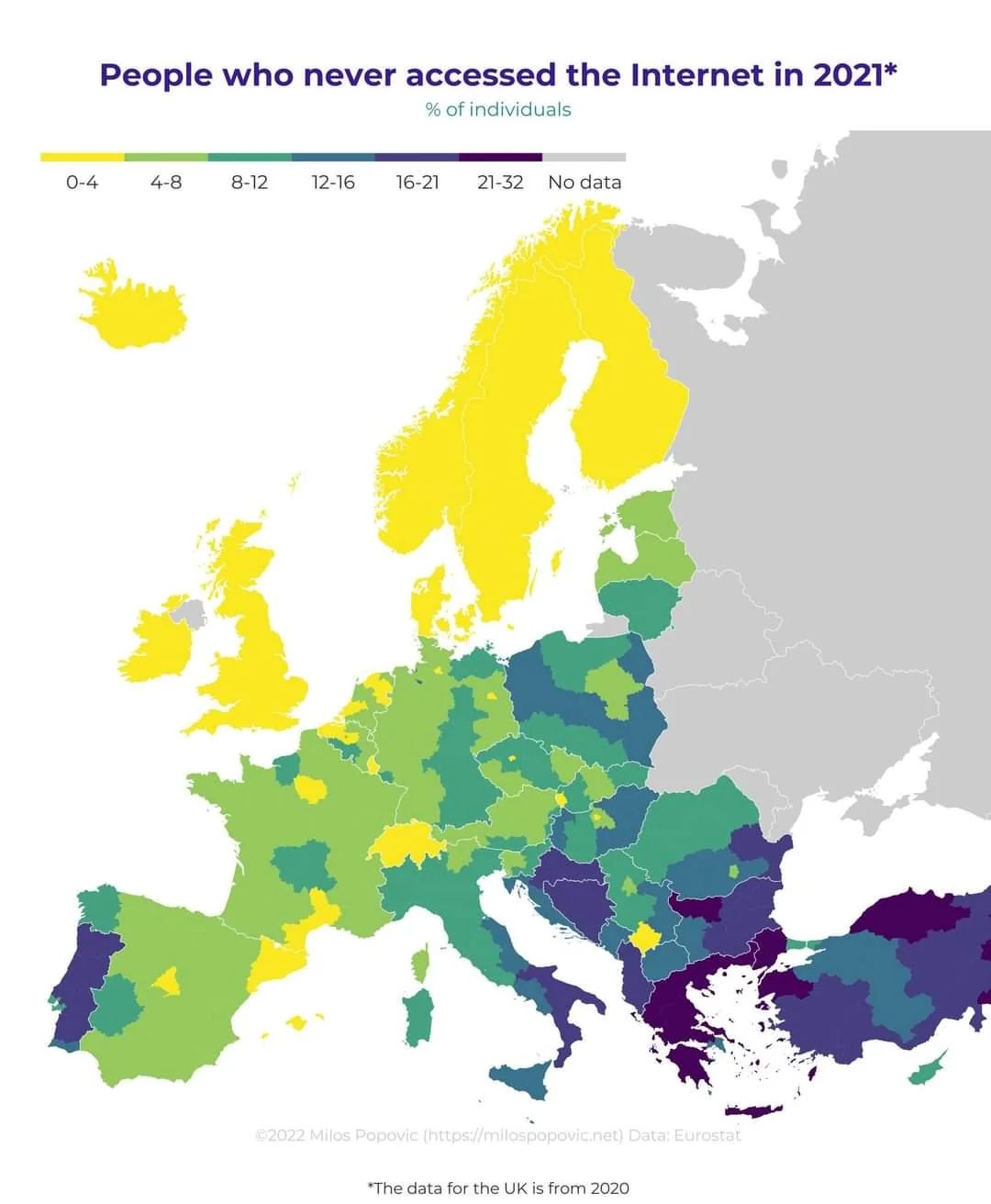
Here is a strong response to this real Describe Image map, taken from our practice set:
"This map illustrates the percentage of individuals who never accessed the internet in 2021 across Europe, based on data from Eurostat. The UK data is from 2020. Colors indicate the percentage of non-internet users, from yellow regions at 0 to 4 percent up to purple at 21 to 32 percent. Countries like Norway, Switzerland, and the Netherlands show the lowest percentages, while higher non-usage rates appear in parts of Eastern Europe and the Balkans. Several countries lack data, shown in gray."
Notice how the answer names the main pattern, the lowest regions, and the highest regions, instead of trying to read out every country.
For more worked examples like this one, see our 50 Describe Image examples with answers, which cover the full range of contexts and patterns you may face.
How "Describe Image" is scored
Describe Image is scored on three things in the official Pearson score guide. Content is worth up to 6 points, while oral fluency and pronunciation are each worth up to 5 points.
Content. This is how well you describe what is in the image. A top answer covers the main parts of the image, the links between them, and where the data is going, such as the highest point or the overall trend. If you describe the wrong image or only say a few words, your content score drops.
Oral fluency. This is how smooth your speech sounds. Pearson looks for a steady, natural speed with good phrasing. Long pauses, repeated words, and false starts lower this score, so it is better to keep going at a calm pace than to stop and restart.
Pronunciation. This is how clear your words are to a regular English speaker. You do not need a particular accent. Pearson accepts different standard kinds of English, as long as your vowels, consonants, and word stress are easy to understand.
Content is scored by both AI and a human reviewer, while oral fluency and pronunciation are scored by AI. The total feeds your overall Speaking score, which is one of the four skills PTE reports, along with Listening, Reading, and Writing. You can read the official bands in the Pearson scoring guide.
Tips to do well on "Describe Image" questions
Use your 25 seconds to find the main trend
During the preparation time, do not try to read every label. Look for the big picture first. Ask yourself: what is the highest value, what is the lowest, and what is the main change over time? Identify the key trends and the single most significant trend before you start speaking. Those few points are the heart of a strong answer.
Follow one simple structure every time
A clear plan stops you from freezing. A reliable shape is: one opening sentence that says what the image is, two or three sentences about the key features, and one closing sentence about the overall trend. Using the same shape for every image lets you focus on the data instead of worrying about what to say next.
Use the numbers from the image
Put numbers from the image into your spoken answer. Numbers prove that you understood the data and they fill your time with real content. You do not need to be exact. Words like "about 200" or "around half" are fine and sound natural.
Keep talking for the full time
Aim to speak for the whole window, close to 40 seconds. If you stop early, you lose the chance to add content and your fluency score can suffer from the silence. If you run out of things to say, describe one more feature or repeat the overall trend in different words. Make your most important points early, in case you run short on time.
Do not over-explain labels
Don't spend your time reading out axis labels and titles word for word. Mention what the image is about, then move quickly to the trends and the data they show. Avoid giving your personal opinion, such as whether you like the result. Describe only what you can actually see.
Speak clearly at a steady pace
Fluency and pronunciation both go up when you slow down a little and breathe between sentences. A calm, even speed is easier to understand than fast speech full of pauses. Practice saying your opening sentence smoothly so the first few seconds set a confident rhythm for the rest of the answer.
How to practice "Describe Image" questions
Saying random images out loud does not help much on its own. You improve fastest when you practice a range of images at your own level and repeat the same simple method until it feels automatic.
On Arno you can record a Describe Image answer and get instant AI scoring on content, oral fluency, and pronunciation, the same three things the real test measures. Instead of guessing whether your answer was good enough, you see your weak points right away and know exactly what to fix before test day.
Click here to create your free account and start practicing Describe Image.
Frequently asked questions
How long do I get for PTE Describe Image?
You get 25 seconds to study the image and prepare, then 40 seconds to speak. The recording starts after a short tone and stops on its own at the end.
How is Describe Image scored?
It is scored on content, oral fluency, and pronunciation. Content is worth up to 6 points, and oral fluency and pronunciation up to 5 points each. Content is checked by both AI and a human reviewer, while fluency and pronunciation are scored by AI. The total adds to your overall Speaking score.
Can I use a memorized template for Describe Image?
No. Pearson says memorized or templated responses can score 0 for content, and if content is 0 your fluency and pronunciation are not scored. Use a simple structure, but describe the real image you see.
What happens if I do not finish in 40 seconds?
The recording stops automatically at 40 seconds. Anything you have not said yet is lost, so make your most important points, like the highest value and the main trend, early in your answer.
Do I need to describe every detail in the image?
No. Trying to mention everything usually leads to rushing and pauses. Focus on the key features and the most significant trend, and support them with a few numbers from the image.
Does my accent lower my Describe Image score?
No. Pearson accepts different standard kinds of English. What matters is that your vowels, consonants, and word stress are clear enough for a regular English speaker to understand.
Conclusion
Describe Image feels hard because you speak alone with no question to lean on. But the task is very predictable. Every image can be handled with the same plan: find the main trend in your 25 seconds, open with one clear sentence, give two or three key features with numbers, and close with the overall trend.
Keep your voice steady, use the full 40 seconds, and never read out a memorized script. Practice this method on a range of charts and pictures, learn from each attempt, and Describe Image will become one of the most reliable points of your Speaking score.